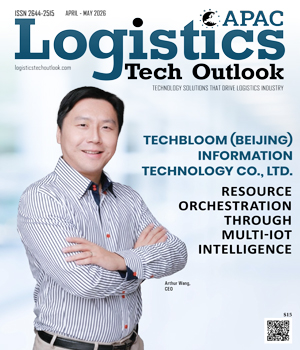
Logistics Tech Outlook

Techbloom (Beijing) Information Technology Co., Ltd.
Resource Orchestration Through Multi-IoT Intelligence

Arthur Wang, Techbloom (Beijing) Information Technology Co., Ltd. | Logistics Tech Outlook | Top Smart Logistics PlatformArthur Wang, CEO
Why do logistics performance breakdowns often stem from unsynchronized shop-floor resources?
In complex logistics environments, performance rarely breaks down because of a single asset. It erodes when operational elements fall out of sync.

After years of studying shop-floor execution, Techbloom (Beijing) Information Technology Co., Ltd identified six on-site resource categories—people, vehicles, machines, items, sites and handling assets—that shape how cost, efficiency, quality and safety unfold in real time.

To operationalize that insight, Techbloom built an integrated multi-IoT architecture anchored by its Wisdom platform. Dedicated IoT hardware and software are deployed across each resource category, while Wisdom acts as the operations analytics and optimization brain. It fuses fragmented shop-floor signals into a real-time digital twin, giving logistics teams stronger accuracy, visibility and speed.

“We shift operations from isolated fixes to site-wide, coordinated optimization,” says Arthur Wang, CEO.

Techbloom customizes deployments through a modular, scenario-based methodology supported by more than 100 standardized logistics solution modules. Rather than redesigning entire workflows, complex operations are broken into sub-scenarios, matched with best-fit modules and assembled into an end-to-end system. As new requirements emerge, new modules are added back into the library, strengthening future delivery.

Converting Execution Data into Decisions

How does Techbloom’s Wisdom platform unify multiple IoT signals into operational intelligence?

Wisdom + multi-IoT fusion architecture reduces idle and overlapping resources, enables time-shared workspaces, lifts productivity and accuracy, and lowers safety risk across people, vehicles and goods. Beyond visibility, its AI layer turns execution data into action by combining status metrics, process relationships and 3D spatial context to detect bottlenecks, forecast risk and recommend or trigger corrective actions.

Where customers authorize automation, Wisdom can issue instructions to connected systems for vehicle dispatch, workflow orchestration and operator guidance. Where human review is preferred, it delivers data-backed recommendations for route planning, labor balancing and layout improvement.

How can multi-IoT data and AI analytics convert shop-floor execution signals into decisions?

To coordinate action on the floor, the platform applies high-precision UWB positioning.

For operators, wearable tags and activity sensors capture working time, idle time, routes and productivity, enabling dynamic dispatch of nearby idle workers to high-load zones. In many deployments, this reduces labor costs by more than 30 percent while supporting flexible, multi-skilled labor.

For vehicles, UWB and onboard sensors measure productive versus non-productive movement, utilization and driver behavior. Dispatch algorithms optimize routes and task assignments, lowering vehicle-related costs by more than 20 percent while improving safety through geofencing and behavior monitoring.

Techbloom applies the same logic to picking through “PTL plus X” solutions. Pick-by-sense removes manual confirmation using bin sensors and wearable wristbands, reducing repetitive motion and detecting errors in real time.

  • We turn fragmented logistics execution into real-time visibility, AI-driven decisions, and coordinated optimization across the entire operation.

Combined with ultra-high-frequency RFID array networks, PTL enables dynamic storage, allowing flexible item placement while continuously tracking precise locations. In deployments, these solutions deliver productivity gains of 30–50 percent and error reductions of up to 99.9 percent while maximizing customer ROI.

In environments with limited fixed sensing or supervisory capacity, Techbloom deploys optimization robots and AI agents as mobile sensing and control layers. Robots collect visual and sensor evidence, detect abnormal behavior, safety hazards and workflow deviations, and provide on-the-spot guidance. In parallel, AI agents pull contextual data from logistics and business systems, analyze issues through Wisdom’s BI and AI modules, and generate next-best actions. Together they create a closed loop between floor execution and back-end intelligence.

Proven Results on the Floor

What measurable operational improvements emerge when logistics resources are coordinated through real-time intelligence?

For a global automotive JV in China, Techbloom replaced manual forklift dispatch with UWB tracking. Within 12 months, the site reduced forklifts and drivers by 20 percent while maintaining service levels, with payback in under 18 months.

For a multinational brand, Wisdom served as a real-time supply chain control tower, connecting upstream transportation status with downstream plant logistics. The result was 100 percent end-to-end monitoring, real-time exception reporting, proactive risk alerts and continuous visibility into 3PL execution.

By unifying six shop-floor resource categories with multi-IoT intelligence, AI optimization and robot-assisted execution, Techbloom helps logistics teams move from fragmented monitoring to continuous, measurable improvement.

Deep Dive

Building Intelligent Control in Smart Logistics Platforms

Digital investment in logistics IoT has accelerated across manufacturing and retail networks, yet many enterprises remain constrained by fragmented visibility. Devices generate data, warehouse systems record transactions and automation executes tasks, but few environments integrate these signals into a unified view that supports measurable improvement. Executives responsible for modern logistics platforms now face a more complex mandate: reduce cost, protect service levels and elevate safety without expanding headcount or asset intensity. True progress depends less on isolated automation and more on how effectively a platform captures and interprets interactions across people, vehicles, machines, materials, spaces and handling assets. When these resource layers are monitored independently, management relies on experience rather than quantifiable evidence. Idle forklifts, uneven labor allocation and excess handling assets often coexist with perceived capacity shortages. A credible logistics platform must therefore convert granular execution data into a comprehensive site model that links resource behavior to throughput, quality and safety outcomes. Visibility alone is insufficient. Static dashboards may describe performance, but they do not rebalance it. Advanced deployments show that value emerges when real-time location, utilization and task data are continuously analyzed and translated into dispatch guidance, route optimization and workload redistribution. Intra-plant transport, picking accuracy and warehouse orchestration improve when the system can distinguish loaded travel from empty movement, productive time from waiting time and correct picks from near misses. Platforms that combine spatial modeling with analytical engines are better positioned to detect delivery risks early, anticipate congestion and guide corrective action before delays escalate. Accuracy at the execution layer remains another decisive factor. Traditional pick-to-light systems reduce errors but still depend on manual confirmation steps and fixed slotting assumptions. Logistics environments that experience SKU proliferation and dynamic storage patterns require sensing architectures that automatically verify location changes, update inventory states and prevent wrong-bin selections in real time. The closer a platform approaches continuous confirmation without adding motion or cognitive burden to workers, the more sustainable the gains in productivity and error reduction. Scalability across diverse facilities also differentiates long-term value. Enterprises operating multi-plant networks cannot afford bespoke redesign for each scenario. A platform built on modular sub-scenarios, capable of decomposing complex workflows into repeatable components, reduces deployment risk and shortens payback periods. When new requirements arise, the ability to integrate additional modules without destabilizing existing processes becomes central to protecting return on investment. Techbloom (Beijing) Information Technology Co., Ltd. presents a cohesive response to these demands through its Wisdom platform and multi-IoT fusion architecture. It integrates dedicated sensing across core resource types, orchestrates data within a 3D digital twin and applies algorithmic dispatch to forklifts, operators and automation assets. Deployments have demonstrated double-digit reductions in vehicle fleets, substantial improvements in equipment utilization and near-elimination of picking errors through PTL+X sensing extensions. Its modular methodology supports site-specific customization while preserving system integrity. For enterprises requiring measurable gains in cost control, throughput reliability and safety performance, it stands out as a disciplined and technically mature choice within the smart logistics platform market. ...Read more
Top Smart Logistics Platform 2026

Company
Techbloom (Beijing) Information Technology Co., Ltd.

Management
Arthur Wang, CEO

Description
Techbloom’s full-stack smart logistics platform unifies people, vehicles, equipment, goods and sites through multi-IoT, digital twins, AI and optimization robots—turning fragmented execution data into real-time visibility, smarter dispatching, safer operations and measurable gains in efficiency, cost, responsiveness and logistics performance.